District 7780 and the Zambia Outreach Team Help a School for the Deaf in Zambia
By Helen Goransson, Zambia Outreach Team, South Berwick-Eliot RC
As the result of the District 7780 February-March 2023 Outreach Team trip to Zambia, members of the South Berwick – Eliot Rotary Club were inspired to assist a school for the deaf. Club members and Zambia Team leader Richard Donhauser and team member Helen Goransson joined with Ashok Surati, then President of the Rotary Club of Mosi oa Tunyua in Livingstone, Zambia, to have his club coordinate this project in country. He introduced us to this project, to his Rotary club, and to Lisa Zahra, director of the DeSanto Centre for the Deaf, who were eager for our help.
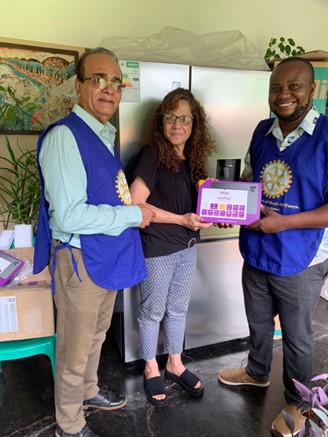
From left to right: Ashok Surati (PP of Rotary Club of Mosi oa Tunyua in Livingstone), Lisa Zahra (Director of DeSanto Centre for the Deaf in Livingstone), and current President Lwanga of the Mosi oa Tunyua Club.
After visiting so many worthy potential projects around Zambia, this one touched our hearts and seemed a good candidate for one of our district grants. This school for the deaf near Livingstone, Zambia, currently serves 27 students but has many needs and room for growth. The first need they identified was for a larger refrigerator. They provide meals for students whose only meals are while they are at the school. Secondly, to assist with learning, they sought computer tablets for the younger students, as well as a modem and support for internet access at the school. The Club was awarded a District Grant for $3495 to fund these items.
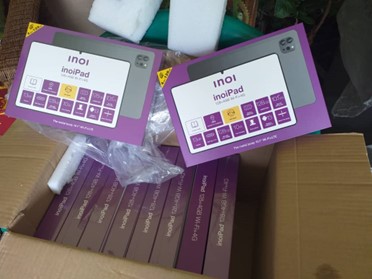
Tablets for the early learners at the school to help study sign language.
As background as to why the need is so great. There are 250 identified deaf children in this region who could benefit from a school like DeSanto. Many come from a distance, needing transportation, which the DeSanto school provides. In their own communities, they would be treated as "throwaway children" whose needs are neglected because of their disability. They would be considered uneducable and therefore would not be properly fed or clothed. Healthy meals, life skills coaching, organized sports, skill building and cooking are all components of the program at DeSanto Centre for the Deaf in addition to traditional schooling. Their families and communities do not know how to communicate effectively with deaf children. For those who become part of the DeSanto school for the deaf, their lives are saved. They receive two healthy meals/day, school uniforms, school supplies and enough education to be able to enter public or private schooling in the future. Their families are taught sign language. Others in the community are offered training in sign language so they can be more comfortable employing and communicating with deaf people in the future. The children can grow up as educated and productive members of their communities. Some can become future teachers at this school or other schools so more deaf children can be served.
Lisa Zahra is the driving force behind the school, having established programs for the deaf more than 20 ago when she arrived in Zambia as a teacher of the deaf and remained in the country. Today, with the help of benefactors locally and around the world, the DeSanto Centre for the Deaf lives on and is constantly improving. With the help of this grant, students and staff will have a better educational experience due to better nutrition and having tablets and internet connectivity. The earlier deaf students learn sign language the more likely their future success. The tablets will be used by the younger students for that purpose.
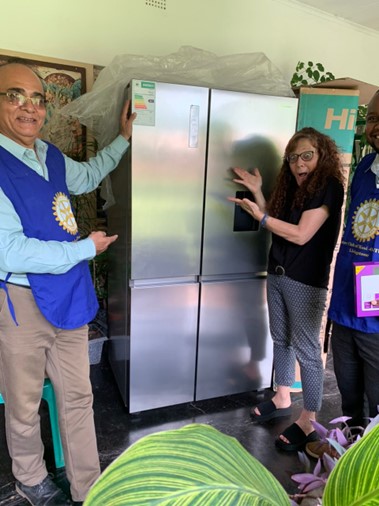
A new refrigerator to help provide 2 nutritious meals per day to the students.
What the future could bring. The Zambia team would love to see a domino effect starting with this school. The families of deaf students will value their children more and learn sign language themselves and share that knowledge with others. The employers in the community will have more well-educated workers from the deaf population to draw from, and these workers will enrich the local economy by being productive rather than being dependent on others to survive. The inhabitants of the communities the children come from will have the benefit of these happy deaf individuals living more fulfilling lives. The country of Zambia, seeing that deaf students can be educated and employed, may change its own policies and educational programs in the future to be more sympathetic and helpful to deaf and other disabled populations.
If the Healthy Learners Program, which our district enabled years ago, which started with a small impact group, could lead to national educational policy changes for all schools in Zambia, then perhaps this model program could lead to national policy changes about the education and treatment of disabled children in that country.
Obviously, like typical Rotarians, we have high hopes.